
CabinTime / Integration Readiness
CabinTime Arrival Decision Intelligence for IFE.
The journey does not end at landing.
CabinTime is an offline-aware journey intelligence application designed for seatback IFE and mobile continuity. It turns flight context, weather, ground transport, destination conditions, and passenger intent into explainable next-step options for arrival.
Why it matters
IFE can prepare the passenger for what happens next.
Traditional IFE is strongest at explaining the flight itself. The passenger still arrives with fragmented decisions ahead: a delayed train, rain after dinner, a congested transfer, an unsuitable venue, or a plan that no longer fits the time available.
CabinTime extends the useful life of the seatback. It organizes arrival conditions before landing, explains why an option is recommended or should be reviewed, and lets the passenger continue the same journey context on mobile.
The passenger makes the final decision. CabinTime creates a state in which that decision can be made with clarity.
Functional prototype evidence
Application-layer behavior you can evaluate today.
The current 1280 x 720 prototype demonstrates the seatback interaction model, journey-state orchestration, source-aware API aggregation, explainable decision output, offline state handling, and mobile handoff.
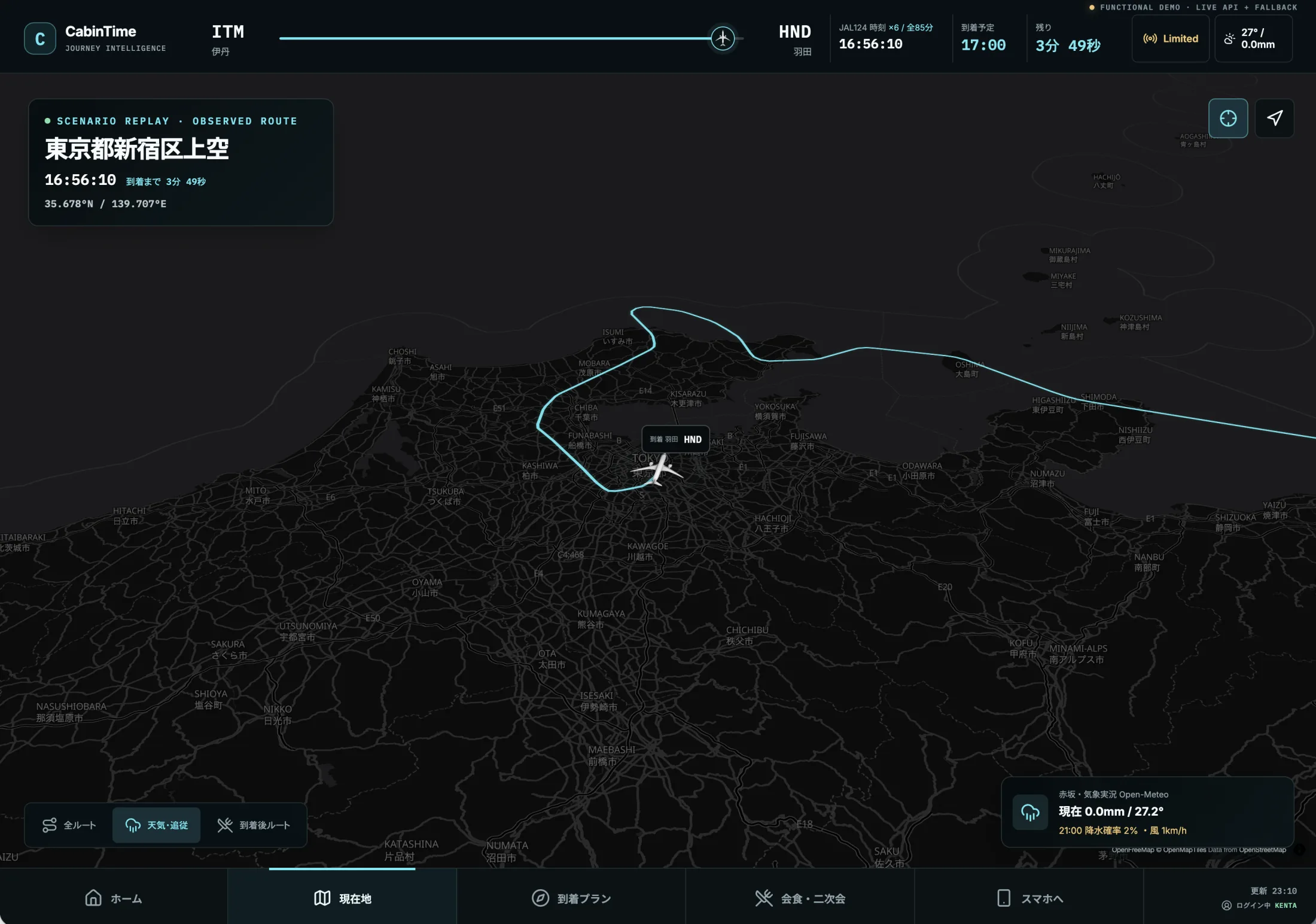
Implemented
Touch-first IFE flow
Live map, arrival brief, route comparison, food and after-plan review, and mobile continuation.
Observable
Network-state behavior
Online, limited, and offline scenarios expose source freshness, cached state, and fallback behavior.
Controlled evaluation
Interactive build available
Technical evaluation uses an interactive build to review navigation, connectivity states, arrival planning, and mobile continuity.
Passenger journey
One journey state across seatback and mobile.
01 / SEATBACK
Understand the arrival context.
Flight progress, destination weather, ground transport, official operator information, trip purpose, and passenger constraints are organized before landing.
02 / ARRIVAL PLAN
Compare, explain, and decide.
Options are expressed as Recommend, Review, Keep, or Avoid, with source, freshness, reasoning, and uncertainty visible to the passenger.
03 / MOBILE CONTINUATION
Continue after leaving the aircraft.
The confirmed destination and journey context move to a passenger-controlled mobile session. Production pairing, expiry, authentication, and encryption remain deployment controls.
Integration Architecture
A defined application core. A replaceable platform edge.
CabinTime keeps journey logic, evidence, and user experience independent from a specific seatback runtime. A Platform Adapter translates partner-approved services into a stable Journey Contract.
Partner-controlled inputs
IFE runtime and approved services
Flight and operations data, passenger context, connectivity state, device I/O, approved content and policy.
Platform Integration Boundary
Platform Adapter
Normalizes vendor APIs, event lifecycle, network state, secure storage, packaging hooks, and device capabilities.
Application Boundary
Journey Intelligence Core
Journey State, decision orchestration, evidence, freshness, graceful degradation, IFE UX, and mobile continuity.
Responsibility Boundary
MarsLink owns the decision-support application layer.
Journey logic, information hierarchy, evidence presentation, source and freshness handling, offline behavior, passenger interaction, and cross-surface continuity remain within the CabinTime application boundary.
Deployment Boundary
The platform partner controls the certified runtime.
Vendor SDK access, aircraft and operations data contracts, device I/O, packaging, signing, certification, airline security review, and deployment approval remain partner-controlled integration gates.
Data Contracts & Interfaces
Every decision carries context, evidence, and time.
The Journey Contract separates official information, observed conditions, scenario assumptions, and AI-assisted judgment. Missing information remains unknown rather than being inferred as fact.
| Contract field | Purpose | Required behavior |
|---|---|---|
| source | Origin of a fact or signal | Visible and attributable |
| observed_at | Time of observation | Preserved through aggregation |
| freshness | Live, recent, cached, or stale state | Changes language and confidence |
| evidence | Reason behind an option | Inspectable by the passenger |
| confidence | Strength of current support | Reduced when data degrades |
| human_confirmation_required | Final-decision control | True for consequential actions |
Runtime & Offline Resilience
Useful behavior under imperfect connectivity.
CabinTime treats connectivity as runtime state, not a binary assumption. Data freshness, available actions, and recommendation confidence change together.
ONLINE
Current APIs and cloud services
Refresh current signals, preserve provenance, and update the Journey State.
LIMITED
Delayed or bandwidth-constrained
Prioritize text, reduce media, apply differential sync, and disclose reduced freshness.
OFFLINE
No external connection
Use approved cached bundles, disable unsupported actions, and queue permitted updates for reconnect.
STALE
Information beyond its validity window
Show a freshness warning, lower confidence, avoid definitive language, and request revalidation.
The functional prototype demonstrates network-state transitions and fallback behavior. Production cache policy, update channels, reconnect queues, and approved offline bundles are defined with the platform partner.
Security & Privacy Model
Trust is an explicit boundary.
CabinTime is designed as a passenger-facing application layer, isolated from aircraft safety and flight-control systems. Production interfaces are expected to be partner-approved and read-only unless explicitly authorized.
Security & Trust Boundary
No command path to safety-critical aircraft systems. Runtime permissions and device access remain platform-controlled.
Data minimization
Use the minimum journey context required for a decision. Separate passenger preferences from official operational information.
Session continuity
Production handoff requires short-lived pairing, encryption in transit and at rest, explicit expiry, and revocation behavior.
Assurance and auditability
Model and rule versions, source timestamps, fallback state, and recommendation evidence are retained for reproducibility.
Production integration applies these controls to the IFE platform's security requirements and the airline's operating requirements.
Certification & Deployment Readiness
A clear path from application proof to approved deployment.
The current CabinTime prototype validates the application-layer UX, decision orchestration, API aggregation, and offline state handling. Seatback runtime integration is defined as a separate platform-adapter boundary.
| Boundary | Current position | Next gate |
|---|---|---|
| Application Boundary | Functional browser prototype, 1280 x 720 touch UX, decision and evidence layer, API and fallback adapters | Partner review of UX and functional scope |
| Data Boundary | Journey Contract, provenance, freshness, cached state, explicit demo-data labels | Approved aircraft, operations, content, and passenger data contracts |
| Platform Integration Boundary | Adapter interface and integration responsibilities defined | Vendor SDK, lifecycle, storage, device I/O, and network-service implementation |
| Security & Trust Boundary | Production control model and isolation requirements defined | Threat model, security review, privacy review, and partner validation |
| Deployment Boundary | Pre-pilot; integration boundaries and evaluation scope defined | Packaging, signing, certification, airline approval, hardware validation, and release operations |
Evaluation path
Define the integration before promising the deployment.
01
Technical evaluation
Review the functional prototype, data boundaries, offline behavior, target hardware, and approved runtime capabilities.
02
Integration workshop
Map vendor APIs, lifecycle events, security controls, data contracts, packaging, signing, and operational ownership.
03
Pilot definition
Agree the route, passenger cohort, hardware environment, success metrics, fallback plan, review gates, and deployment responsibilities.
Work with MarsLink
Evaluate CabinTime as an IFE application and integration program.
We welcome technical evaluation with airlines, IFE platform providers, and cabin-connectivity teams. The first conversation is about fit, interfaces, constraints, and evidence.